Subject Guide

Mountain West
Malachite’s Big Hole



Knives:
The design of knives used by the mountain men in the early 1800’s, including “long knives” and “bowies” differed little from designs used throughout Europe back to the middle ages. Important types of knives used or shipped to the mountains included clasp knives, butcher knives, scalpers, bear knives and skinning knives. Important variations were the Green River Knife, and the Bowie Knife.
In the early 1800’s most knives in use in the United States were imported from England. The knife-making guilds of Sheffield manufactured a product of superior and consistent quality. Although blacksmith manufactured knives of domestic origin were available, these never found widespread acceptance for lack of consistent quality. It wasn’t until the J. Russell & Company – Green River Works began manufacturing cutlery in the later part of the 1830’s that domestic knives began to find widespread acceptance by the U.S. Consumer.
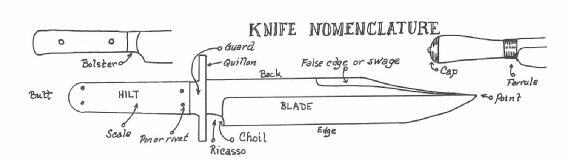
The figure below shows general naming conventions for the parts of a knife. This figure is modified from that shown on page 4 of the Fur Trade Cutlery Sketchbook, by James Hanson.
 Frequent use of knives for butchering and skinning would have quickly dulled the
cutting edge. A sharpening stone or whetstone would have been a necessary part of
the trappers outfit.
Frequent use of knives for butchering and skinning would have quickly dulled the
cutting edge. A sharpening stone or whetstone would have been a necessary part of
the trappers outfit.
Clasp Knives or folding knives (jack knives) were often used in trade with the Indians. Even though the clothing usually worn by the Western Indian had no pockets, these knives turn up at historical sites everywhere. The blade of these knives might be as much as 4 inches long, which would fold into a handle of wood or bone. The blade would be held in the open or closed position by a spring, however, these were not switchblades. Used for light duty cutting.
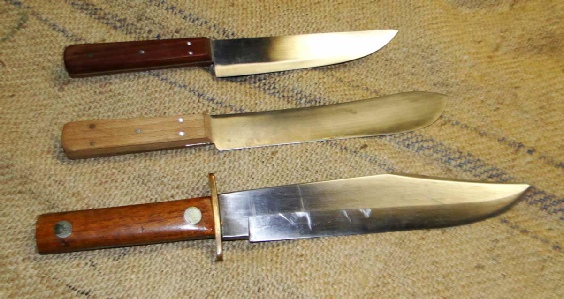
Butcher Knives or Scalpers, were a rigid one piece knife. These knives were the everyday implement of living and survival in the mountains and were used for most meat and game processing, butchering, skinning and other light and heavy duty cutting tasks, including occasional scalping (a specialized form of skinning) and digging graves Butcher knives came in multiple shapes and sizes, some of which were better suited to certain tasks, such as skinning than others. A Scalper is the name given to a particular style of butcher knife. In which the back of the blade ran straight to the tip. Although called a scalper, the pattern was no more effective at taking scalps than any other pattern of butcher knife. The pattern was a favorite among the Indians because it was relatively less expensive than the standard butcher knife. The cost difference was due only to the shape of the blade, being a simpler shape the blade required less effort and produced less waste than the standard butcher pattern which swept up at the tip. Below is an image showing a scalper, a butcher and a Bowie knife.
 The most famous domestic manufacturer of butcher knives was J. Russell & Company
– Green River Works, and the Green River Knife has come to be synonymous with the
mountain man and the fur trade in popular lore. In fact the "Green River Knife"
on which the reputation and fame of the company rested was not produced until near
the end of 1837, and the earliest western inventory on which I’ve seen it listed
is 1843, years after the last rendezvous was held (See the myth of the Green River
Knife). The Green River Knife was in fact the knife of choice for the Oregon and
California emigrant, buffalo hunter, gold miner, Indian and trapper alike. The “Green
River Knife” was named after the factory location at which it was manufactured,
The Green River Works, located on the Green River at Greenfield, Massachusetts, not
Green River, Wyoming. The Green River Works manufactured a variety of butcher and
kitchen knives, and the name came to be synonymous with quality. Company manufactured
knives were equal or superior in quality to those made at established European cutlery
makers such as Sheffield, and at comparable prices. “Green River Works” was stamped
on the blade of the knives, often near the handle. By the 1840's, the Green River
Works was shipping more than 50,000 blades a year and from 1840 to 1860 sent more
than 60,000 dozen knives out west. Ultimately, the European manufacturers copied
the Green River styles, even to stamping “Green River” on the blades. The expression
“Up to Green River” was commonly used to describe a “job well done” – a metaphor
for perfection or high quality. Another variation was the phrase “Up to the Green
River” meaning someone was stabbed, with the knife penetrating up to the handle.
For more information regarding the Green River Works, J. Russell & Co., or the Green
River Knife
The most famous domestic manufacturer of butcher knives was J. Russell & Company
– Green River Works, and the Green River Knife has come to be synonymous with the
mountain man and the fur trade in popular lore. In fact the "Green River Knife"
on which the reputation and fame of the company rested was not produced until near
the end of 1837, and the earliest western inventory on which I’ve seen it listed
is 1843, years after the last rendezvous was held (See the myth of the Green River
Knife). The Green River Knife was in fact the knife of choice for the Oregon and
California emigrant, buffalo hunter, gold miner, Indian and trapper alike. The “Green
River Knife” was named after the factory location at which it was manufactured,
The Green River Works, located on the Green River at Greenfield, Massachusetts, not
Green River, Wyoming. The Green River Works manufactured a variety of butcher and
kitchen knives, and the name came to be synonymous with quality. Company manufactured
knives were equal or superior in quality to those made at established European cutlery
makers such as Sheffield, and at comparable prices. “Green River Works” was stamped
on the blade of the knives, often near the handle. By the 1840's, the Green River
Works was shipping more than 50,000 blades a year and from 1840 to 1860 sent more
than 60,000 dozen knives out west. Ultimately, the European manufacturers copied
the Green River styles, even to stamping “Green River” on the blades. The expression
“Up to Green River” was commonly used to describe a “job well done” – a metaphor
for perfection or high quality. Another variation was the phrase “Up to the Green
River” meaning someone was stabbed, with the knife penetrating up to the handle.
For more information regarding the Green River Works, J. Russell & Co., or the Green
River Knife
The Bowie Knife had a large heavy blade, which might be as much as 12 inches long. The knife had a clipped point, or drop point, which may have been sharpened on the upper edge as well. Finally the Bowie Knife had a guard. Although knives of similar design are known from Europe back to the middle ages, the “Bowie Knife” design was made famous by Jim Bowie, a result of his notorious character and a well publicized altercation, which is probably a myth, in which the knife supposedly played a major role. It’s not likely that the mountain men carried knives of this style. Butchers or scalpers would be more functional for skinning or cutting meat, whereas a tomahawk or belt axe would be more useful for heavy cutting or chopping.
Skinning Knives. The skinning knife is one type of specialized knife used for removing hides and skins from the carcass. This knife is another variation of the butcher except the tip is swept up far more than the standard butcher. Although any knife could be used for skinning an animal, these knives were designed or modified to allow more rapid removal of skin from the carcass while minimizing risk of damage to the hide. Both white and Indian alike would often regrind the knife so that there was a bevel on only one side to minimize slashing the hide during removal. For the same reason, these knives also often had an edge with a pronounced curve, and lacked a sharp point. This type of knife came into widespread use by the buffalo hunters following the Civil War.
I’ve not found documentation that hunter/trappers in the mountains used trap springs in the following manner. According to one contemporary source who reported that those (trapper/hunters originally based out of Taos and moved on to settle in California) who owned vineyards found that the steel springs of the beaver traps "had just the right shape to be forged into pruning knives," (source Foster, "Pioneers of Los Angeles," Historical Society of Southern California, 1887, 35.) It’s my opinion that it is not likely that only mountain men turned vintners noticed that trap springs could be used for knife making material. Trap springs may well have provided source material for emergency fabrication of knives in the mountains as well.
For more information about knives and cutlery see the following references:
Hanson, James A. The Fur Trade Cutlery Sketchbook, 1994, published by The Fur Press, Crawford, Nebraska.
Russell, Carl P. Firearms, Traps, & Tools of the Mountain Men, published by University of New Mexico Press, 1967. 448 Pages.
Back to the Top
Back to Equipment